Light-It Up
- 4.6
- Rating
- 50.00M
- Installs
- Free
- Price

 Analysis by App-foxy
I picked up Light-It Up expecting a quick arcade distraction, and that is exactly where it works best. It is a stickman jumping game built around movement, timing, and brightening dark shapes as you move through them. The idea is easy to understand within seconds, but the later challenge comes from controlling momentum rather than simply tapping as fast as possible.
That simple setup gives the game a useful kind of portability. I can play it while waiting for a coffee, take a few attempts during a short break, or stay with it longer when I want something more focused without learning a complicated rule set. It is free to start, aimed at Everyone, and comes from CrazyLabs LTD, so it fits naturally among casual arcade games rather than story-heavy platformers or competitive multiplayer titles.
My overall impression is positive, with one important qualification: this is a game for people who enjoy repeating a short challenge until the timing feels right. If you want exploration, character development, or a large amount of variety between sessions, its compact arcade structure may feel limited. If you like quick retries and the satisfaction of finally making a difficult jump, it has a much stronger appeal.
You May Also Like

 Blood Strike: 2.5 Anniversary
Blood Strike’s Loadouts Turn Every Drop Into a Tactical Gamble
A close look at Blood Strike’s custom loadouts: how fast access to signature weapons reshapes its battle royale rhythm, rewards preparation, and narrows the gap between fights.

 Pandora - Music & Podcasts
Pandora’s Music Is Easy to Start, but Harder to Recover
Pandora’s strength is its low-effort path from a seed to a station. Its weak spot is how much confidence it asks you to place in connection, setup, and quiet recovery.

 8 Ball Pool
 Is Built on Rivalries, Rematches, and Routine
A close look at the rivalries, rematches, shared routines, and unanswered safety questions that turn a quick pool match into a persistent mobile community.

 Samsung Music
’s Quiet Strength Is Playing What You Already Own
Its reach comes less from spectacle than from dependable access to a personal library. That simplicity is both the app’s strongest retention engine and its ceiling.

 AccuWeather: Weather Radar
AccuWeather Review: A Quick, Clear Forecast for Everyday Decisions
For everyday plans, the best forecast is the one you can understand quickly. AccuWeather makes rain timing, radar, and local conditions easy to act on, with a few trade-offs.

 Hill Climb Racing
Why Hill Climb Racing Still Turns Crashes Into One More Run
A tiny car, a bumpy hill and one more upgrade: Hill Climb Racing keeps resurfacing because its simple chaos makes every near-miss feel personal.
More From Our News Desk



How the current version feels in everyday play
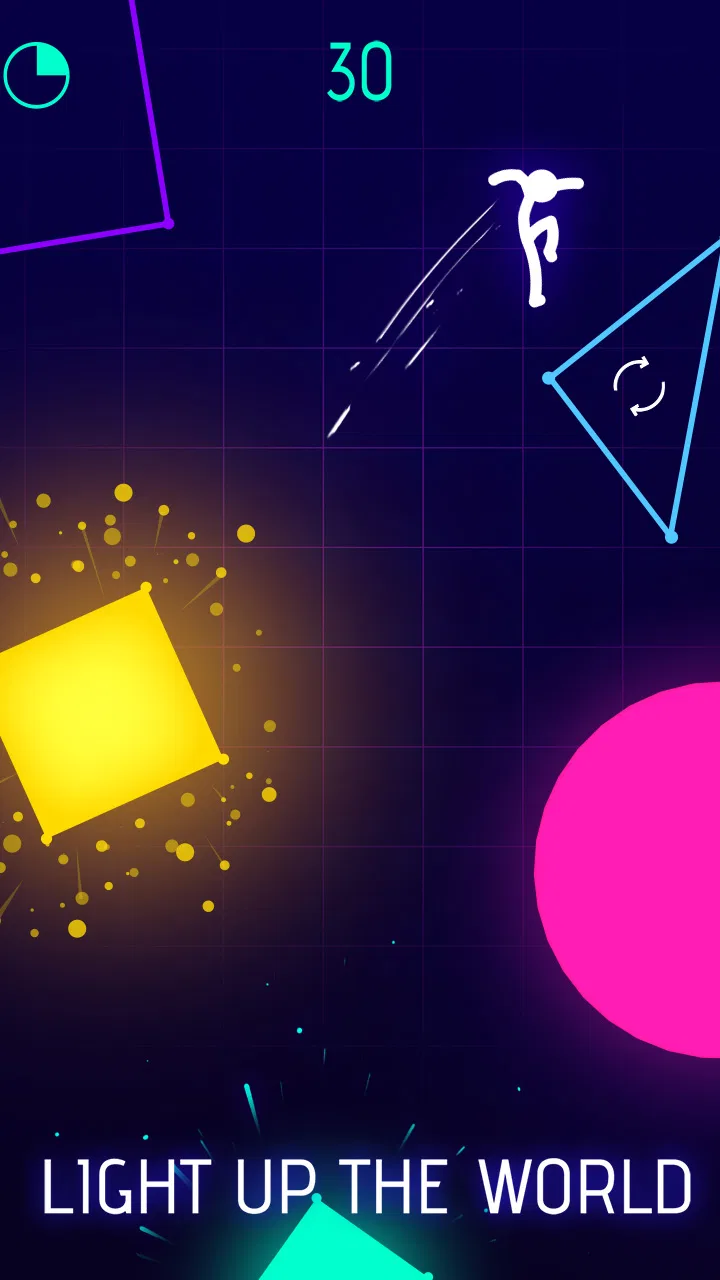
The core loop is wonderfully direct. I guide the stickman through a dark arrangement of platforms, jump from one shape to the next, and try to touch the elements that bring the scene to life. There is no long tutorial to work through before the game becomes playable. The first few moments teach the basic relationship between a jump, a landing, and the illuminated environment.
What makes the controls more interesting than they initially appear is the need to read the next landing while the character is already moving. A jump that looks safe can become awkward if I approach the platform from the wrong side or commit to the next direction too early. That creates a rhythm of observation, movement, correction, and retrying. The game is accessible, but it is not always forgiving.
I found the visual contrast especially useful during play. The dark background and bright platforms make the active route easy to identify, while the stickman remains visually clear enough to follow during quick jumps. This is not a realistic presentation, and it does not try to be. Its style serves the arcade purpose: show me where to go, make successful movement feel vivid, and keep the screen readable when the pace increases.
In an everyday scenario, I would use it during a commute or while waiting for an appointment, but I would not treat every session as a relaxed time killer. A short level can still demand concentration, particularly when I am trying to improve a failed attempt. The game is convenient for brief play because the basic action starts quickly, yet the challenge can pull me into several retries before I put the phone away.
That balance is one of its strongest qualities. Many casual games are easy to open but too passive to hold my attention. Here, each attempt gives me a clear personal question: did I mistime the jump, choose the wrong approach, or react too late? The answer is usually visible in the failure itself, which makes another attempt feel worthwhile rather than random.
Movement rewards patience more than frantic tapping
My most useful adjustment was to stop treating every jump as an emergency. The natural reaction is to tap quickly whenever the character is airborne, but that can make a landing worse. I had better results when I watched the shape of the next platform, considered where the stickman would arrive, and used smaller corrections instead of constant input.
This is a concrete difference between playing casually and playing well. A new player can reach the early sections through instinct, but harder sequences encourage a more deliberate approach. I began looking one platform ahead rather than staring only at the character. That small change improved my consistency and also made the game feel less like a reflex test and more like a compact movement puzzle.
Another helpful habit is accepting that a failed attempt has information in it. If I repeatedly miss on the same side, the problem is often not bad luck. I may be starting the jump too close to an edge, correcting too late, or entering the next movement with the wrong direction. Because the levels are short and the action is immediate, testing one change at a time is more productive than simply repeating the same motion.
The best way to approach difficult sections is to turn each retry into a small experiment. I pay attention to the takeoff point, the highest part of the jump, and the landing angle. That method is more satisfying than rushing, and it is also the reason the game can remain engaging after the basic controls become familiar.
Who will enjoy it, and who may lose interest
Light-It Up suits players who want an arcade game with a low barrier to entry and a meaningful skill curve. It is a good choice for someone who likes platforming but does not want a large map, lengthy dialogue, or a complicated inventory. It also works for people who enjoy chasing a cleaner attempt after making a small mistake.
I would recommend it to a friend who often plays in short bursts but still wants the game to demand attention. It is also a reasonable option for younger players because the content rating is Everyone and the presentation is built around abstract shapes and a stickman rather than mature themes. Adults who prefer calm, slow-paced games should know that the bright style does not remove the frustration of missing the same jump several times.
On the other hand, I would not choose it for someone looking for a conventional platform adventure. There is no reason to expect the exploration, character customization, narrative progression, or broad world-building found in larger games. It is also not the right match for a player who dislikes restarting after mistakes. The whole design depends on trying again, and that repetition is central rather than incidental.
Compared with endless runners, this feels more intentional because the route is something I can study instead of merely reacting to an uninterrupted stream of obstacles. Compared with traditional platformers, it is more compact and less concerned with building a world. Compared with puzzle games, it asks for physical timing as much as planning. That middle ground is its identity, but it also means players seeking a deeper version of any one of those genres may prefer a more specialized alternative.
What the release history tells existing players
The game was released on December 20, 2018, and the current version is 1.9.5.4. I see that as evidence of a product that has had time to settle into its arcade format rather than a brand-new experiment still searching for its direction. The important point for an existing player is not to expect a completely different game from an update number alone. The central experience remains the jump-and-illuminate loop.
For someone installing it today, the current version matters because it represents the form available now, not the earliest release. That makes the game easier to judge as a complete casual title. I would still approach it with realistic expectations: version progression does not automatically mean a large expansion, a new genre direction, or a replacement for a full platform adventure. The appeal remains concentrated in quick movement challenges.
The Android requirement is also relatively approachable, with support beginning at version 7.0. That makes it a practical candidate for people using an older compatible device, although the experience will naturally depend on the phone itself. I would close other demanding apps before playing if the device is modest, not because the game is presented as technically demanding, but because smoother input is valuable in a timing-based arcade game.
Its audience size reinforces that this is not an obscure experimental release. It has passed over ten million installs and holds a 4.6 average from around 215 thousand ratings, alongside roughly 13 thousand written reviews. Those figures suggest broad appeal, but I would not read them as a promise that every player will enjoy the retry-heavy design. Popularity can tell me that the concept connects with many people; it cannot remove the personal question of whether I like precision arcade play.
Free access and the practical trade-off
The game is free, which makes trying it straightforward. I can install it without committing money first and decide whether the controls and level structure suit me. That is particularly useful here because the main question is not whether the concept sounds interesting, but whether repeated attempts feel satisfying on my own device and with my own tolerance for failure.
There are in-app purchases ranging from $0.99 to $19.99 per item. I would keep that in mind before handing the game to a child or leaving purchases unrestricted. A free download is not the same as an entirely purchase-free experience, and the listed range means optional spending can vary considerably. My advice is simple: play the opening portion without buying anything, then decide whether any paid option genuinely improves your experience rather than using it to bypass frustration.
This is also where the game differs from a paid arcade title. A one-time purchase can feel cleaner for players who want every part of the experience defined upfront. The free model is better for casual testing and occasional play, but it may be less appealing to someone who wants a completely controlled spending environment. I would choose based on that trade-off rather than assuming free automatically means better value.
Small techniques that make the game less frustrating
First, I recommend playing with a stable grip and keeping the screen unobstructed. The controls may be simple, but a cramped hand position makes tiny corrections harder. This matters most when a sequence requires several jumps in succession, because one uncomfortable adjustment can affect the next landing.
Second, I avoid judging a route only by its brightest or largest platform. The apparent target is not always the best place to prepare for the following jump. I look at the next two landing opportunities when possible, because arriving safely is only half the problem; arriving in a useful position can make the following movement much easier.
Third, I separate learning attempts from performance attempts. During a learning attempt, I deliberately observe what happens after a particular input. During a performance attempt, I use the timing I have already learned and avoid changing several things at once. This prevents the common cycle of random retries where every failure feels different and no clear lesson emerges.
Fourth, I stop after frustration starts changing my timing. The game is well suited to short sessions, and taking a break can be more effective than forcing another ten attempts with increasingly rushed inputs. When I return, the route often feels more readable because I am no longer reacting emotionally to the previous miss.
These habits are not hidden buttons or secret systems; they are ways of getting more from the specific movement design. They also reveal the game’s main strength: improvement comes from understanding the relationship between position and timing, not from collecting a complicated set of upgrades.
Where the experience still has limits
The same focus that makes the game easy to start can make it feel narrow over a long session. The stickman, dark-and-bright visual language, and jump-based structure establish a clear identity, but players who need constant changes in scenery or mechanics may eventually want something broader. I noticed that the appeal is strongest when I play with a specific goal, such as clearing a troublesome section or improving my control.
There is also a difference between challenge and variety. A harder sequence can extend the life of the core mechanic, but it does not necessarily provide the freshness of a new gameplay system. If I am already tired of timing jumps, more demanding timing will not solve that problem. In that situation, a puzzle game, a traditional platformer, or an endless runner with a different interaction model would be a better change of pace.
The game may also frustrate players who want progress to feel generous. Its satisfaction comes from my improvement, not from the character becoming dramatically stronger. That is an important distinction. If I prefer upgrades that make later attempts easier, I may find this structure demanding because the solution is usually better execution rather than a stronger avatar.
Finally, the free-to-play format deserves attention even when I am enjoying the gameplay. The purchase range is broad enough that I would review any confirmation screen carefully. I would also avoid assuming that a paid item is necessary to understand the game. The sensible first step is to experience the basic arcade loop, decide whether it earns regular play, and only then consider spending.
What I would watch before making it a long-term favorite
For new players, I would watch how quickly the controls become comfortable. The first session should answer whether the movement feels precise enough for you. If the character seems to move in a way you cannot predict, the game may remain irritating rather than rewarding. If each miss gives you a clear idea of what to change, there is a good chance the challenge will grow on you.
For returning players, I would pay attention to whether the current version continues to give you meaningful reasons to revisit the levels. The established release history is reassuring in the sense that the game has remained available and recognizable, but long-term enjoyment still depends on how much you value mastery of the existing arcade structure. I would not install it expecting a different genre to emerge later.
I would also watch my own spending behavior. Because the game is free to begin, it is easy to treat a purchase as a quick solution after a difficult run. I prefer to wait, take a break, and try the section again before paying for anything. That keeps the decision connected to genuine enjoyment instead of temporary frustration.
On a compatible Android device, the low minimum operating-system requirement makes it accessible to a broad range of users. The game is free and suitable for Everyone, while its 4.6 average and audience of more than ten million installs show that the formula has reached a substantial player base. Those are useful reasons to try it, but the final test is still personal: do you enjoy learning jumps through repetition?
My recommendation is yes, with clear boundaries. Install it if you want a bright, focused arcade game that starts quickly and rewards careful timing. Use short sessions, study the next landing rather than tapping wildly, and treat mistakes as information. Skip it if you need a story, exploration, multiplayer competition, or a constantly changing set of mechanics. For the right player, Light-It Up is a compact test of timing that turns a very simple idea into a surprisingly absorbing routine.
FAQs for Light-It Up
01What is the main objective of Light-It Up?
Light-It Up is a dynamic platformer game where the primary objective is to illuminate dark shapes by jumping on them. Players control a stickman character who flips, jumps, and glides through various levels, lighting up all the shapes to progress. It's a test of reflexes and timing, offering both challenge and entertainment.
02Is Light-It Up suitable for all ages?
Yes, Light-It Up is designed to be suitable for players of all ages. Its simple mechanics and vibrant graphics make it appealing to both children and adults. However, the difficulty may increase in later levels, providing a fun challenge for older players while still being accessible to younger audiences.
03Does Light-It Up require an internet connection to play?
Light-It Up can be played offline, making it a great option for gaming on the go without needing a data connection. This allows players to enjoy the game anytime, anywhere, without worrying about connectivity issues. However, online features, if any, may require an internet connection.
04Are there in-app purchases in Light-It Up?
Yes, Light-It Up offers in-app purchases. These may include options to remove ads, unlock additional levels, or acquire special abilities and features. While the game is free to download, these purchases can enhance the gaming experience, though they are entirely optional for players.
05What are some tips for mastering Light-It Up?
To excel in Light-It Up, players should focus on timing their jumps precisely to land on shapes and keep their stickman character illuminated. Practicing levels to learn the layout and anticipating the motion of shapes can greatly improve performance. Patience and practice are key to mastering the game.
Pros
- Intuitive controls make gameplay smooth.
- Visually appealing neon graphics.
- Challenging levels increase replay value.
- Quick load times enhance user experience.
- No intrusive ads for distraction-free play.
Cons
- Limited soundtrack variety.
- Can become repetitive over time.
- Occasional minor bugs.
- Requires internet for certain features.
- In-app purchases can be pricey.

Light-It Up
Gallery